
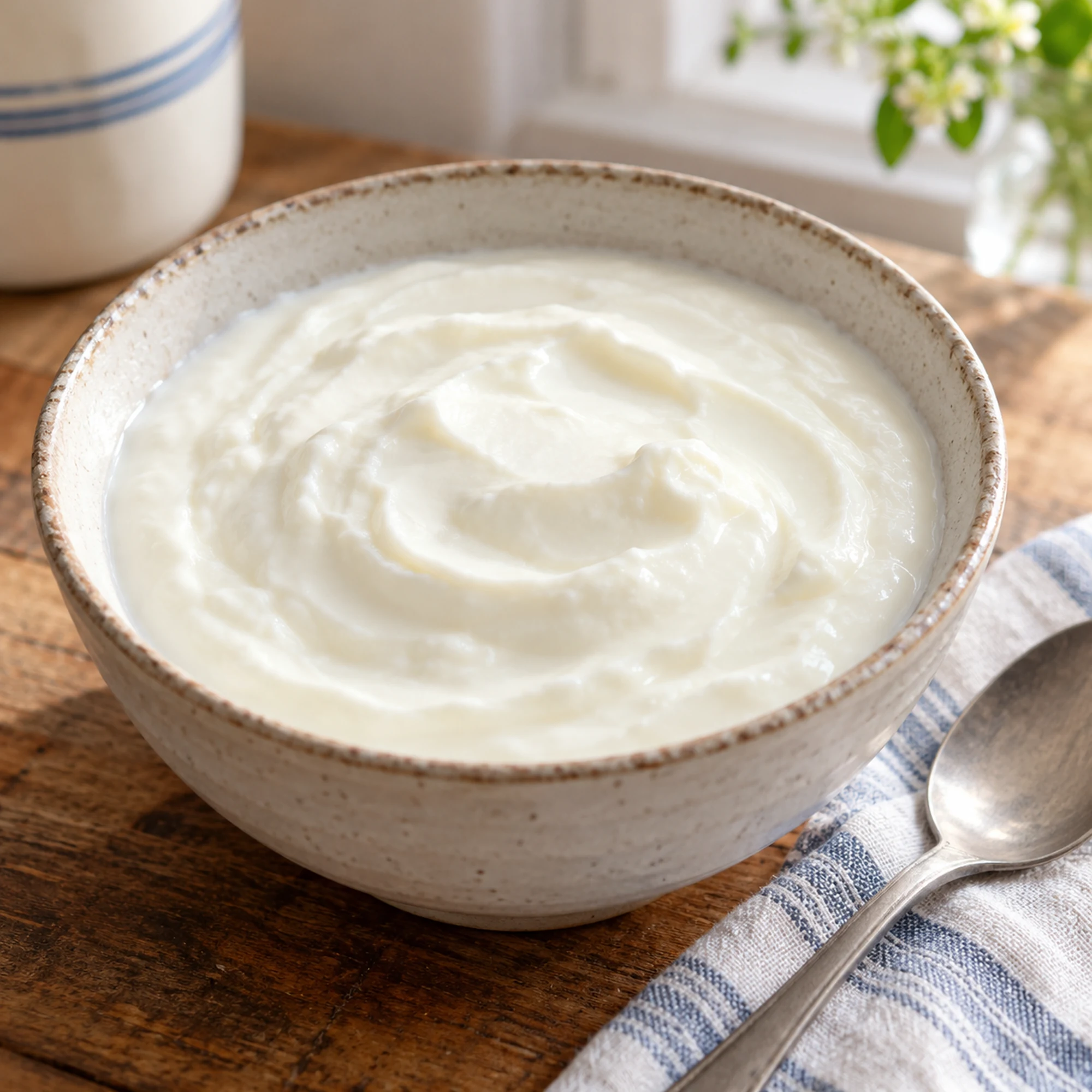
Ingredients
- 2 quarts pasteurized whole milk 8 cups / 1.9 L
- 1/2 cup plain whole-milk yogurt 120 g; fresh, with live and active cultures
Equipment
- 4-quart heavy saucepan
- Food thermometer
- Whisk and small bowl
- Heat-safe glass jars and suitable lids
- Yogurt maker or incubator maintaining 110°F / 43°C
Instructions
- Wash hands and clean the work surface. Wash the heat-safe jars and utensils in hot soapy water, rinse, then sterilize them in boiling water for 10 minutes and air-dry. Prepare suitable clean lids according to their manufacturer's directions. Set up an incubator that reliably maintains 110°F (43°C).
- Pour the pasteurized milk into the heavy saucepan. Heat gently, stirring frequently, to 185°F (85°C); hold around 185°F for 10 minutes without boiling. Stir carefully to avoid scorching.
- Cool the milk to 112–115°F (44–46°C), about 20–30 minutes; an ice-water bath can help. Whisk the starter with a little cooled milk in a small bowl, then stir it into the saucepan. The mixture should be about 110°F (43°C).
- Pour into the prepared containers, cover and incubate undisturbed at 110°F (43°C), within about 5°F (3°C), for 4–7 hours until properly set. Follow the incubator manufacturer's operating directions and monitor temperature. Discard a batch that fails to set properly.
- Refrigerate the set yogurt promptly at 40°F (4°C) or colder for at least 4 hours before serving. Makes approximately 8 cups; divide into 8 roughly 1-cup servings.
Nutrition
Serving: 1approximately 1-cup servingCalories: 170kcalCarbohydrates: 14gProtein: 9gFat: 8gSodium: 140mg
Video
Notes
Estimated nutrition is for plain, unstrained yogurt without toppings. The timing includes up to 30 minutes cooling, 7 hours incubation and 4 hours chilling; actual incubation varies. Use pasteurized milk and fresh plain yogurt with live and active cultures. Store covered at 40°F (4°C) or colder and use within 7 days; discard any abnormal batch.
Instructional video: Downshiftology. Downshiftology demonstrates the same heat-cool-culture method with a yogurt maker; this card uses a larger batch and its own starter quantity and incubation window.
Cost is a planning estimate using assumed US grocery unit prices for the quantities used; local prices vary. Nutrition is an approximate ingredient calculation, not a laboratory analysis.
